
NEW DELHI: Hours after the killing of Iran’s Supreme Leader Ayatollah Ali Khamenei in a sweeping US–Israel operation, Tehran launched what it described as a broad retaliatory campaign targeting American and Israeli military assets across the Middle East.Iran’s Islamic Revolutionary Guard Corps (IRGC) claimed that all Israeli and US military targets in the region had been struck “by the powerful blows of Iranian missiles”.“This operation will continue relentlessly until the enemy is decisively defeated,” the IRGC said, adding that all US assets throughout the region were now considered legitimate targets.The scale and geography of the attacks have triggered a pressing question: is the United States struggling to safeguard its military footprint in the Gulf, and are its layered air defence systems being stretched to their limits?
A multi-front retaliation across the Gulf
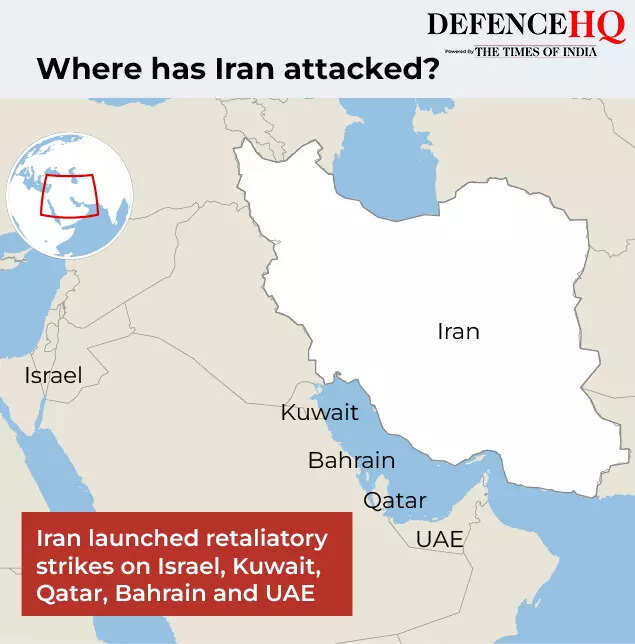
Iran’s retaliation was not confined to a single theatre. According to Iranian state-linked outlets and regional media, missiles and drones were launched towards US-linked assets in Bahrain, Kuwait, Qatar, the United Arab Emirates and Iraq’s Kurdish region.In Abu Dhabi, at least one person was reported killed after several missiles launched from Iran were intercepted, according to the UAE’s state news agency. A fire broke out near a hotel on Dubai’s Palm Jumeirah after what officials later described as an “incident” in a building that injured four people.Footage verified by BBC showed thick smoke rising from a luxury hotel in Dubai, while other videos captured loud explosions and interceptions in the skies over Doha and Manama.
.
In Bahrain, the government confirmed that a missile attack targeted the headquarters of the US Navy’s Fifth Fleet in Manama. The kingdom described it as a “treacherous attack” and “a blatant violation of the kingdom’s sovereignty and security”.Video circulating on social media appeared to show a drone striking a tower block near the naval headquarters, setting it ablaze. Bahrain’s Interior Ministry said several residential buildings had been hit and civil defence teams were engaged in rescue and firefighting operations.
CENTCOM confirms US casualties
Amid the barrage of claims and counterclaims, US Central Command issued an update from Tampa, Florida.“As of 9:30 am ET, March 1, three US service members have been killed in action and five are seriously wounded as part of Operation Epic Fury,” CENTCOM said.Several others sustained minor shrapnel injuries and concussions and were being returned to duty, it added, noting that major combat operations continued and the situation remained fluid.The confirmation of American fatalities marks a significant escalation, raising the stakes for Washington and reinforcing concerns over the vulnerability of forward-deployed US forces.
Kuwait and Qatar: Bases under fire
In Kuwait, the defence ministry said Ali al-Salem Air Base came under attack by ballistic missiles, all of which were intercepted by Kuwaiti air defence systems. However, a drone targeted Kuwait International Airport, leaving employees with minor injuries and causing material damage.Kuwait’s Foreign Ministry said the country maintained its right to defend itself.In Qatar, the defence ministry said it had “thwarted” attacks under a “pre-approved security plan”, intercepting all missiles before they reached the country’s territory. Sources speaking to Al Jazeera reported that a long-range early warning radar in northern Qatar had been targeted.The Qatari foreign ministry called the attack “a flagrant violation of its national sovereignty” and “an unacceptable escalation”, noting that Doha had sought to distance itself from regional conflicts.
Saudi Arabia and Iraq drawn in
Saudi Arabia confirmed that Iran had targeted Riyadh and the kingdom’s eastern region, adding that the attacks were repelled.“These attacks cannot be justified under any pretext or in any way,” the Saudi foreign ministry said, stressing that the kingdom had previously confirmed it would not allow its territory to be used to target Iran.In Iraq, Erbil International Airport in the Kurdish region was reportedly targeted twice. US air defences shot down a drone near a US military base close to Erbil, according to Reuters. The Iraqi government later confirmed air strikes on Jurf al-Nasr, a military base housing Kataib Hezbollah elements integrated into the regular army.Kataib Hezbollah warned that it would soon begin attacking American bases “in response to their aggression”.
Iran claims strike on USS Abraham Lincoln, US denies hit
Iran’s Islamic Revolutionary Guard Corps escalated its rhetoric by claiming it had directly struck a major US naval asset in the Gulf.“The US aircraft carrier Abraham Lincoln was struck by four ballistic missiles,” AFP quoted the Guards as saying, as Tehran sought to portray the attack as a significant blow to American military power in the region.However, the United States swiftly rejected the claim.“Iran’s IRGC claims to have struck USS Abraham Lincoln with ballistic missiles. LIE. The Lincoln was not hit. The missiles launched didn’t even come close. The Lincoln continues to launch aircraft in support of CENTCOM’s relentless campaign to defend the American people by eliminating threats from the Iranian regime,” US Central Command said.Despite Washington’s denial, the IRGC maintained its hardline tone, warning that “the land and sea will increasingly become the graveyard of the terrorist aggressors”.In a separate development, US Central Command said an Iranian Jamaran-class corvette was struck during the opening phase of Operation Epic Fury and was sinking near Chah Bahar in the Gulf of Oman.The naval dimension of the confrontation, involving aircraft carriers, destroyers and support vessels, has introduced a new layer of strategic risk to an already volatile regional conflict, raising concerns about further escalation at sea.
“Will keep the gates of hell open”: Iran
Iran signalled that the campaign was far from over. In what it called the fifth wave of “Operation True Promise 4”, the IRGC said a ship carrying ammunition for American vessels at Jebel Ali anchorage had been hit and “completely disabled”.It also claimed that “The American naval base in the Abdullah Mubarak area of Kuwait was hit by 4 ballistic missiles and 12 drones, and all the infrastructure was destroyed, and a large number of American forces were killed and injured.”“The IRGC Navy, along with the air force, will keep the gates of hell open to enemy units,” it added.Independent verification of the scale of damage remains limited, but the rhetoric underscores Tehran’s intent to broaden the battlefield.
US Air defence under strain?
Across the region, Patriot systems and other missile defence batteries were activated repeatedly. In Doha, Accroding to Al Jazeera witnesses reported hearing at least a dozen explosions that sounded like Patriot interceptors engaging incoming missiles.The United States maintains about 13 military bases across the Middle East, with between 30,000 and 40,000 troops typically deployed.While many missiles were intercepted, the sheer number of launches and the geographic spread of targets have raised questions about the sustainability of constant high-alert operations and the strain on interceptor inventories.Even successful interceptions come at a cost. Patriot missiles and other high-end interceptors are expensive and finite, and saturation attacks can test the limits of layered defences.
Strait of Hormuz: A global chokepoint at risk
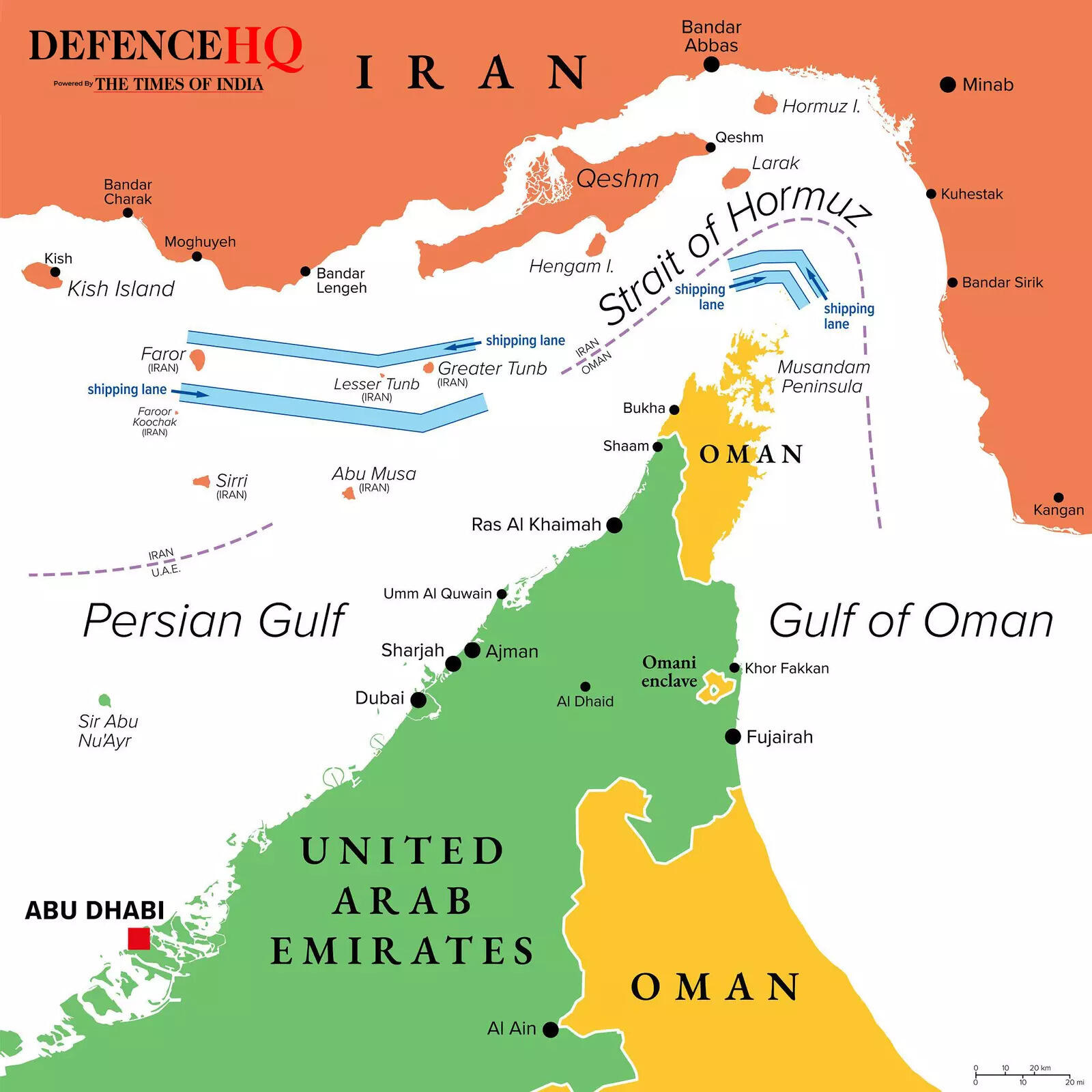
The conflict also reverberated across global energy markets. The UK Maritime Trade Operations agency said vessels in the Gulf had received warnings about the possible closure of the Strait of Hormuz.Roughly one fifth of the world’s oil and gas passes through the strait, making it one of the most critical maritime chokepoints globally. Any prolonged disruption could trigger sharp spikes in oil prices and destabilise global markets.
.
Qatar, Kuwait, Bahrain and the UAE temporarily closed their airspace, further signalling the severity of the escalation.
Iran’s diplomatic defence
Iran’s Deputy foreign minister Hamid Ghanbari told Al Jazeera that Tehran had the right to defend itself and regretted any humanitarian losses caused by the escalation.Foreign Minister Abbas Araghchi wrote to the UN Security Council and Secretary-General Antonio Guterres, stating that Iran would “continue to exercise its right of self-defence decisively and without hesitation until the aggression ceases fully and unequivocally”.Araghchi later said the killing of Khamenei was “a very serious and unprecedented act and a blatant violation of international law”, adding: “We have no restrictions or limits in defending ourselves.”He confirmed that a Transitional Council had been established to manage affairs following the leadership vacuum.