
At 9, Aahana checks her mother’s phone before brushing her teeth. By the time she leaves for school in Gurugram, she has scrolled through multiple short-video feeds, probably texted in two group chats. Her mother says she worries about how much she is engaged now to what happens on a screen.Across India’s cities and small towns, this scene is no longer unusual. Smartphones are often handed to children before they enter their teens, at times when they are toddlers. Social media accounts, sometimes created despite platform age limits, follow soon after. What began as a tool for communication has become an ecosystem where friendships, validation and identity increasingly take shape.

Now, as countries from Australia to the United Kingdom tighten digital safety norms for minors, India faces a policy crossroads: confronting a difficult question: should social media platforms be off-limits for those under 15? The debate is no longer theoretical, rather have shifted from anecdotal parental anxiety to a public health and regulatory conversation backed by research. Mental health professionals are reporting patterns. Concerns around screen addiction, online bullying, harmful content and declining mental health indicators among adolescents have pushed policymakers to study global precedents worldwide to consider stricter age-gating laws. In India, home to over 250 million adolescents and one of the world’s largest internet user bases, the stakes are significantly higher. For millions of Indian children, the smartphone is no longer a device of privilege but of routine. Classrooms moved online during the pandemic. Friendships migrated to messaging apps. Entertainment, identity formation and peer validation increasingly unfold through short videos and algorithm-driven feeds. Yet, alongside opportunity lies unease: how much exposure is too much, and at what age? The question is no longer whether social media affects children. It is whether prohibition is the answer, or whether regulation, design reform and digital literacy can achieve better outcomes.
Global regulatory shifts: A growing policy trend
Governments have begun responding to mounting evidence linking heavy social media use to mental health challenges among adolescents. And in effect have moved toward stronger age restrictions on social media use.In Australia, the government has moved from debate to implementation. The Online Safety Amendment (Social Media Minimum Age) Act 2024 took effect on 10 December 2025, making Australia the first country to ban social media accounts for users under 16, with platforms required to take “reasonable steps” to block access or face significant fines. Early evaluation of the law’s impacts, on youth wellbeing, family dynamics and usage patterns, has begun, with findings to be published through 2026 and beyond. In the United Kingdom, the Online Safety Act continues to impose stricter obligations on platforms to protect children from harmful or explicit material and enforce age-appropriate design. Regulators have fined major services for failing to adequately verify users’ ages, and the government is now consulting on potentially raising age restrictions or even exploring a formal under-16 ban after Australia’s example. Elsewhere in Europe, several countries are actively pushing similar measures. Poland’s ruling party is preparing legislation to ban social media for children under 15 and mandate robust age verification, while France, Denmark and other EU states are debating or enacting age limits between 15–16 years. Efforts toward a harmonised EU approach are gaining political traction amid rising concern over youth mental health, as reported by Reuters.
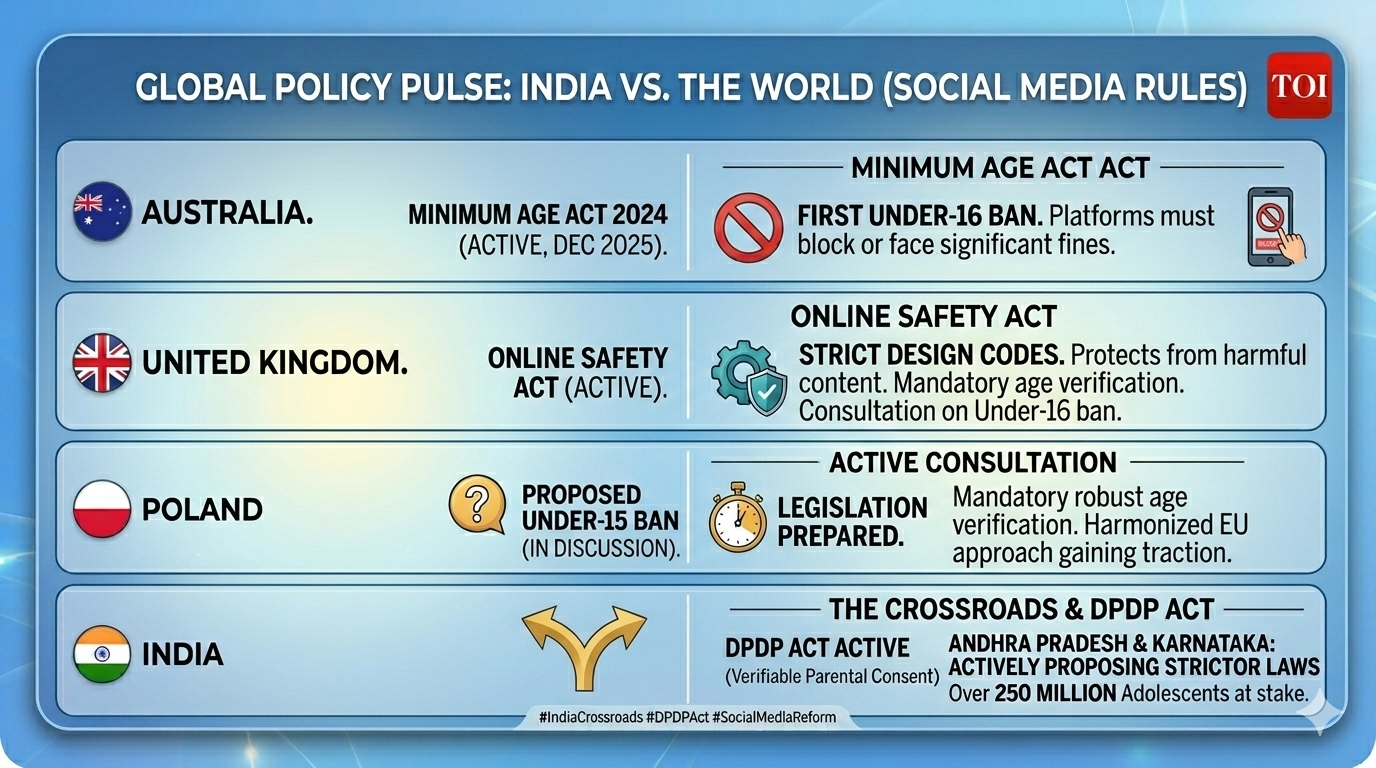
In the United States, the picture remains complex and contested. Multiple state laws aimed at age verification, parental consent or outright limits on minors’ social media use have been introduced. Notably, a Virginia law that would have limited under-16 usage to one hour daily and required age checks was blocked by a federal court in February 2026 for infringing constitutional speech rights, illustrating the legal challenges such measures face. While outright bans are still uncommon and legally fraught in the US, the direction of travel is clear: policymakers are increasingly shifting accountability from families to technology companies through design rules, verification obligations, and platform-level safeguards.The global policy shift is emphasised by mounting research linking heavy social media use among adolescents to anxiety, depression, sleep disturbances and body image issues, concerns now cited widely on public health grounds rather than purely moral arguments.For India, observing these global experiments offers both cautionary and instructive lessons. Enforcement challenges, the privacy implications of stringent age verification, and constitutional protections around free speech and access to information complicate the feasibility of blanket prohibitions. Ongoing debate reflects these tensions, with commentators urging a balanced focus on digital literacy, safer defaults, and family-oriented safeguards rather than top-down bans alone.
The impact of social media on children: Evidence and counterpoints
Screen time, mental health and behavioural risks
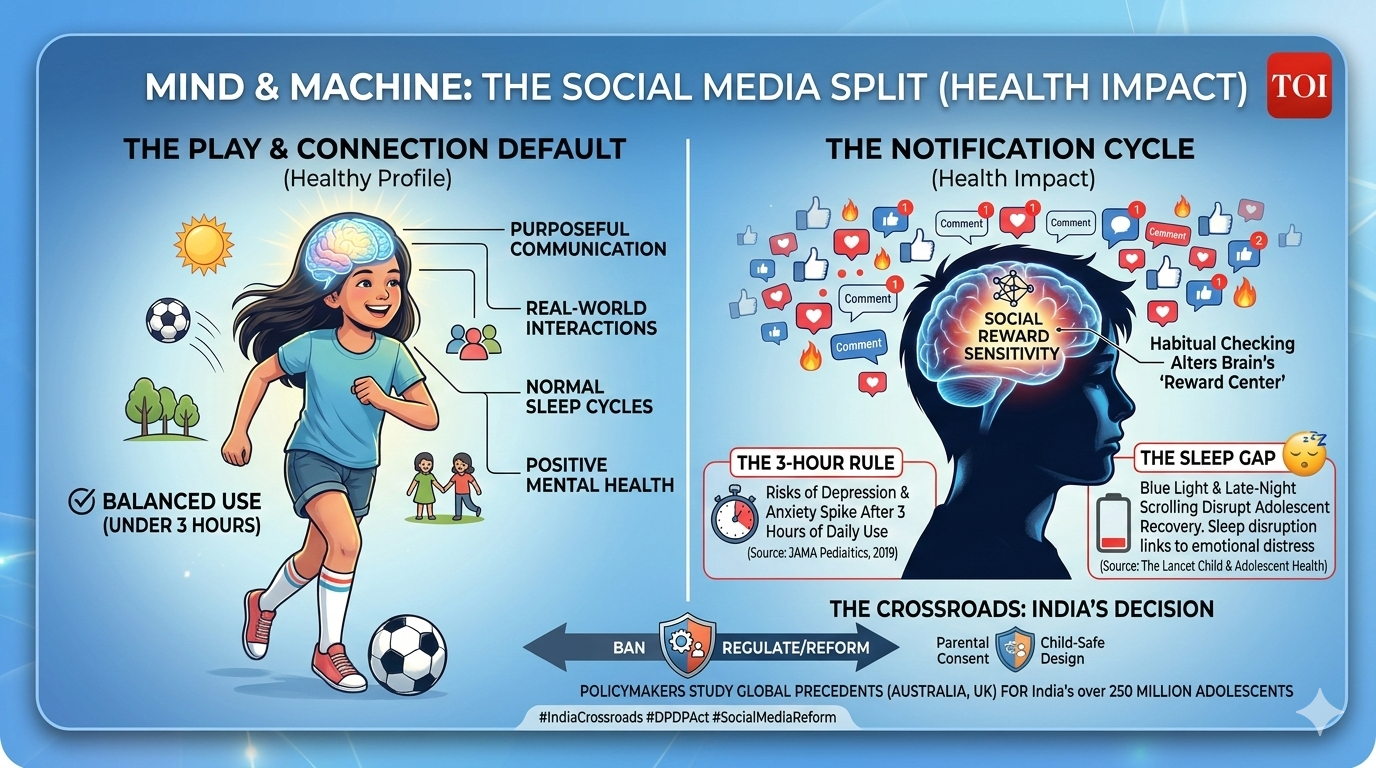
Research has consistently flagged correlations between excessive social media use and adverse psychological outcomes in adolescents.A 2019 study published in JAMA Pediatrics tracked nearly 6,600 adolescents and found that those spending more than three hours a day on social media faced a significantly higher risk of mental health problems, particularly internalising symptoms such as anxiety and depression.In 2023, another study in the same journal reported that habitual checking of social media was associated with changes in brain development patterns related to social reward sensitivity in early adolescence. While researchers cautioned that correlation does not prove causation, they noted measurable neural differences in frequent users.Similar research published in The Lancet Child & Adolescent Health has found that heavy social media use among teenage girls was associated with poorer sleep, lower self-esteem and higher rates of depressive symptoms. Sleep disruption emerged as a key pathway linking screen exposure to emotional distress.
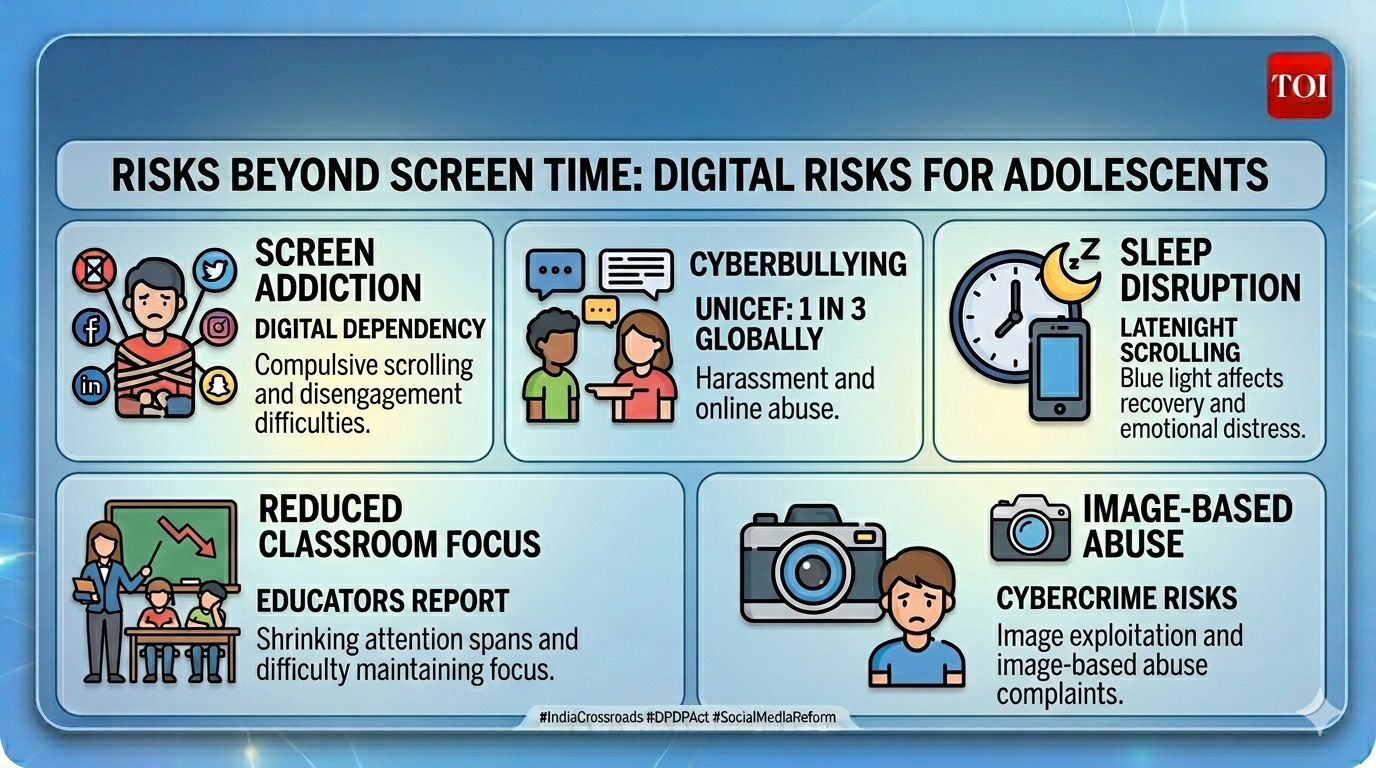
The WHO has flagged problematic digital use as a growing behavioural concern, noting associations with sedentary lifestyles, cyberbullying and compulsive use patterns.Dr Rhea Mehra, a Delhi-based child psychiatrist, says she has observed a steady increase in digital dependency cases among children aged 11 to 15. “We are seeing children who struggle to disengage from their devices, whose mood fluctuates based on online interactions,” she says. “In some cases, sleep cycles are severely disrupted because screen time extends past midnight (when left unchecked).”She adds that early adolescence is a vulnerable developmental stage. “Impulse control and emotional regulation are still developing. Social media platforms are designed around instant feedback and comparison, which can amplify insecurities.”
Cyberbullying and exposure risks
The risks are not limited to screen duration.A UNICEF report has highlighted that one in three young people globally reports experiencing cyberbullying. In India, cybercrime data show increasing complaints involving minors, including harassment and image-based abuse.Parents recount similar concerns. “It’s not just about time,” says Mohit, a Delhi-based father of an 11-year-old. “It’s about what they are seeing. There are trends and challenges that can be dangerous. And sometimes we don’t even know what’s circulating in their groups.”Another parent, Prathamesh Singh from Pune, says monitoring has become a daily task. “You don’t want to invade privacy, but you can’t be completely hands-off either. It’s a constant balancing act.”
Academic and developmental concerns
Educators report shrinking attention spans and difficulty maintaining classroom focus. Studies have linked excessive device use to reduced academic performance, though causation remains debated.Dr Mehra notes, “Some children show signs of reduced face-to-face social skills. They are comfortable online but anxious in real-world interactions.”
The counterpoint: Not all use is harmful
Research also cautions against sweeping conclusions.Studies have shown that moderate, purposeful use, such as communicating with known peers, does not uniformly predict poor mental health. For some adolescents, online communities provide support, particularly for those who feel isolated offline.The American Psychological Association has stated that the impact of social media depends on content, duration and individual vulnerability factors.“Blanket demonisation of technology is not helpful,” Dr Mehra says. “The question is how it is used, at what age and with what safeguards.”
India’s regulatory landscape: What exists
India does not currently ban social media for minors under 15. Most platforms prohibit users under 13, consistent with global standards, but enforcement relies largely on self-declared age.The Digital Personal Data Protection Act, 2023, mandates verifiable parental consent for processing children’s data and places obligations on data fiduciaries to protect minors’ information.The IT Rules, require intermediaries to remove unlawful content and establish grievance mechanisms. However, age verification remains technically and administratively complex. India’s vast user base, with hundreds of millions of internet subscribers, makes enforcement challenging.Legal experts also note that any outright ban would have to withstand scrutiny under constitutional protections related to speech and access to information, as interpreted by the Supreme Court of India.Enforcement, however, is India’s perennial challenge. With millions of new internet users each year and widespread access to shared devices, age-based prohibitions could prove difficult to implement uniformly. Rural-urban divides, digital literacy levels and socio-economic disparities further complicate the regulatory equation.
Should India impose a ban?
Among parents of children under 15, opinion is divided.Those advocating a ban argue that children under 15 lack the cognitive maturity to navigate algorithm-driven ecosystems designed for engagement maximisation. Some favour stricter age barriers, citing distraction, exposure to inappropriate content and peer pressure. Others worry that an outright ban would push usage underground, making monitoring harder.
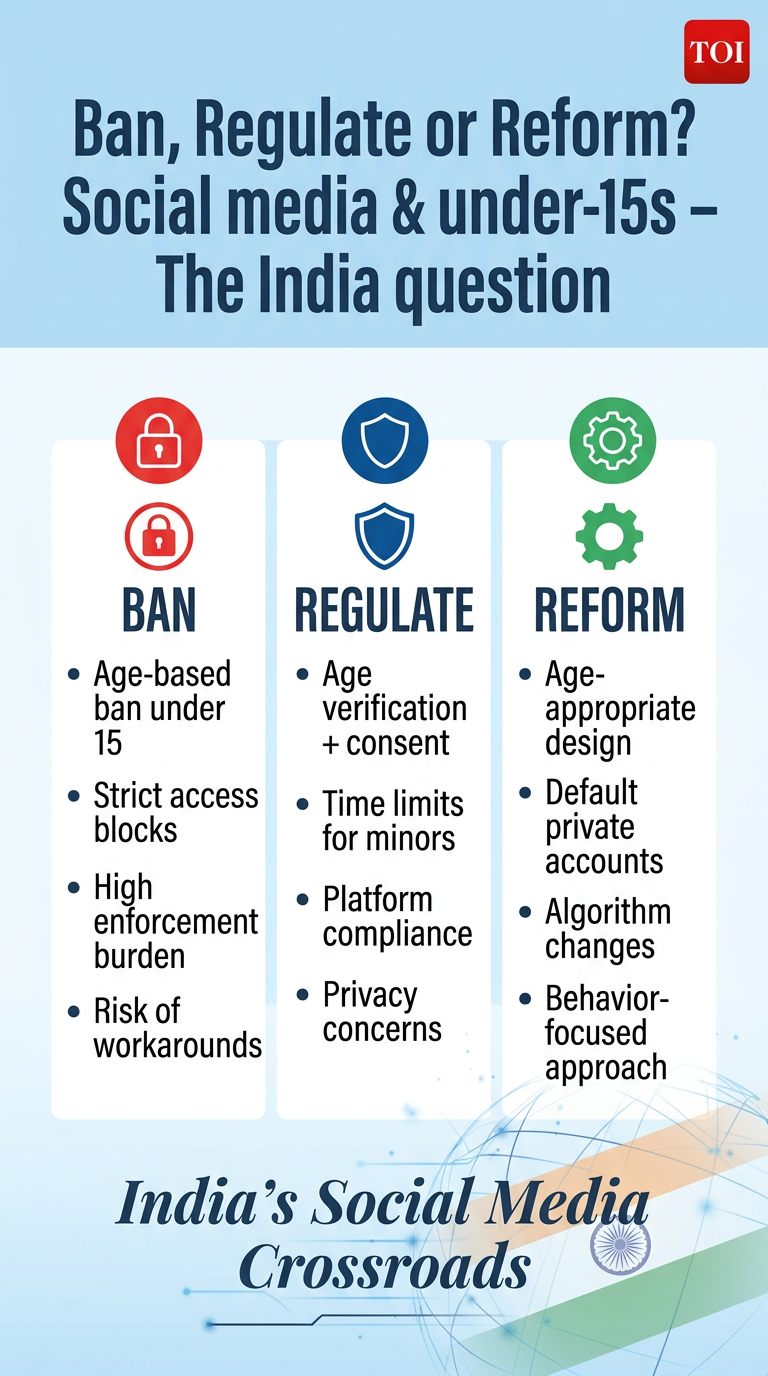
Parents describe a daily negotiation: balancing academic needs with leisure use, setting screen-time limits and modelling digital discipline themselves. Many acknowledge that devices have become integral to schooling and social belonging, making complete prohibition unrealistic.“Regulation has not kept pace with platform design,” says Dr Mehra. “Younger adolescents are particularly susceptible to peer comparison and online validation cycles.” On the regulation front, the argument in policy circles is also that, don’t wait for regulations, as current regulations are neither adequate, nor sufficient, nor can be termed as over -regulations.Parents like Mohit support stricter age thresholds. “If there was a clear law, it would make it easier for parents to say no,” he says. However, critics question feasibility. Children may bypass age checks using older relatives’ credentials. Overly intrusive verification could compromise privacy. And educational, creative and social benefits may be curtailed. Prathamesh believes prohibition could backfire. “If you ban it outright, they will find workarounds. It might push things underground.”Public health experts increasingly suggest a layered approach rather than an absolute ban.Child psychiatrists in metropolitan centres report an uptick in consultations linked to excessive gaming, social media dependency and anxiety triggered by online comparison. At the same time, mental health professionals caution against attributing complex psychological issues solely to social media. Family dynamics, academic stress, urban isolation and pandemic after-effects also play substantial roles.
What India could consider
Borrowing from the UK’s age-appropriate design code, India could mandate that platforms default minors to private accounts, disable targeted advertising, remove public follower counts for young users, and limit algorithmic amplification of sensitive content. This approach shifts focus from access to environment.There is also a case for time-bound restrictions rather than outright bans, for instance, limiting usage hours for verified minor accounts or mandating built-in digital well-being tools. However, such measures depend heavily on platform cooperation and technical integration.Digital literacy is another lever. Experts argue that equipping children with critical thinking skills, teaching parents to set boundaries, and integrating online safety modules into school curricula may prove more sustainable than prohibition. The ministry of education’s ongoing digital awareness programmes could be expanded to include structured modules on cyberbullying, misinformation and privacy.
The constitutional and social balancing act
Any move toward a ban would likely invite legal scrutiny. Access to the internet has been described by courts as integral to freedom of expression and trade in certain contexts. While reasonable restrictions to protect minors are permissible, proportionality would be tested.India’s demographic reality adds complexity. A large chunk of its population is under 18. A uniform prohibition for under-15s could affect tens of millions of users, a scale unmatched by most Western nations experimenting with similar policies. Socio-economic context matters too. For children in resource-constrained settings, free digital platforms often double as learning tools, networking spaces and gateways to opportunities. Restrictive policies could inadvertently widen inequality if alternative safe platforms are not simultaneously developed.
Policy options include:
Public health experts increasingly advocate a layered approach:
- Stronger age-verification systems, balanced against privacy concerns.
- Age-appropriate design mandates, such as disabling targeted ads for minors and limiting algorithmic amplification.
- Increase transparency in algorithms that recommend content to young users.
- Default privacy settings for verified minor accounts.
- Enforce stricter data protection norms for minors.
- Strengthen reporting mechanisms for cyberbullying and harmful material.
- Invest in digital literacy education for both children and parents.
- Clearer parental control frameworks built into platforms.
Dr Mehra supports design reform. “If platforms reduced visible metrics like follower counts for minors, it could lower comparison anxiety,” she says.Research published in JAMA Pediatrics and The Lancet Child & Adolescent Health suggests that intensity and type of engagement matter more than mere access. Policymakers may therefore need to focus on the environment rather than outright exclusion.Such a framework recognises that the digital ecosystem is unlikely to recede. Instead of attempting to eliminate children’s access entirely, regulation could focus on reshaping the environment in which that access occurs.
Conversation already underway
Within India, the conversation is no longer theoretical. Andhra Pradesh has emerged as one of the most proactive states examining whether social media access should be restricted for school-going children. During a recent Assembly session, state home minister Vangalapudi Anitha informed lawmakers that a proposed law could limit social media use among minors. A government sub-group has since begun reviewing regulatory models, including age-based access controls and mechanisms to curb misinformation.IT and HRD minister Nara Lokesh publicly articulated the state’s concerns. In a post on X, he wrote:“Trust in social media is breaking down. Children are slipping into relentless usage, affecting their attention spans and education. Women are facing non-stop online abuse. This cannot be ignored.”He further noted that children below a certain age may lack the emotional maturity to process harmful online content, adding that the government is studying global best practices, including Australia’s under-16 framework. Official data cited by the state indicates over 1,300 cases linked to inappropriate online content, with more than 1,000 individuals taken into custody before court proceedings, figures that underscore enforcement challenges already underway.At the national level, TDP parliamentary party leader Lavu Sri Krishna Devarayalu has submitted a memorandum to Union minister Ashwini Vaishnaw seeking structured consultations on age-based regulation for minors. The Centre is expected to consider forming an expert panel before advancing any nationwide framework.Karnataka, meanwhile, is adopting a consultative approach. Chief minister Siddaramaiah recently sought feedback from university vice chancellors on restricting mobile phone use among students, referencing measures discussed in countries such as Australia, Finland and the UK.“Today we are discussing this… I want your opinion on this. We are looking at this,” he said, clarifying that any proposal would focus on minors rather than adult learners.Deputy chief minister DK Shivakumar has also raised concerns over rising screen dependence among youth. At the same time, Karnataka has rolled out a digital wellbeing initiative in partnership with Meta, covering nearly three lakh students and one lakh educators. The programme emphasises responsible and mindful technology use rather than outright bans, with outcomes currently under review. Together, these state-level experiments illustrate India’s emerging dilemma: whether to impose strict age-based bans, strengthen regulatory oversight, or prioritise digital literacy and behavioural reform. As debates intensify, the country appears to be testing multiple pathways before settling on a unified national position.
The balancing act ahead
The debate over banning social media for under-15s in India is ultimately about more than apps or algorithms. It reflects a broader anxiety about childhood in a hyperconnected age.India has one of the world’s youngest populations. Any move affecting under-15 users would impact tens of millions of families. The global momentum toward tighter regulation provides reference points, but India’s scale and diversity demand context-specific solutions.The evidence shows associations between heavy social media use and mental health risks, particularly among early adolescents. It also shows nuance: not every user experiences harm, and not every platform interaction is detrimental.For parents like Mohit, the question remains immediate. “We didn’t grow up like this. We are learning as we go,” he says.For clinicians like Dr Mehra, the trend is visible but complex. “This is not a single-cause issue. But social media is now a significant variable in childhood development.”Whether India chooses to ban, regulate or redesign access for under-15s, the policy must rest on evidence, enforceability and proportionality. The debate is less about whether children are online, they already are, and more about what kind of digital environment the country is willing to permit for them.