
At 10:01 GMT this morning, something happened that has been happening for 4.5 billion years, and yet remains quietly astonishing: Earth arrived at the precise point in its orbit where neither pole leans toward the Sun. For one suspended instant, our restless, tilted planet was perfectly balanced relative to its star. This is the spring equinox, and it is far more than a calendar date.It is the moment when the machinery of seasons shifts. It triggers migration, flowering, breeding, and thaw. It is a celestial event that civilisations across history have watched for, built monuments to, and celebrated with ritual and ceremony. At its core lies a simple truth: a single geometrical relationship, the 23.5-degree tilt of Earth, shapes nearly everything alive.At the equinox, the Sun rises due east and sets due west from every point on Earth, one of only two times each year when this alignment holds true worldwide.
A moment of balance that changes the living world
Earth does not orbit the Sun upright. Its axis leans at 23.5 degrees, likely the result of a colossal collision with a Mars-sized body early in its history. That impact formed the Moon and gave Earth its tilt. Without it, there would be no seasons. The tropics would remain constantly hot, the poles permanently frozen, and the temperate zones far less dynamic than they are today.The direction of this tilt remains fixed in space, pointing roughly toward Polaris. What changes over the year is which hemisphere faces the Sun. In June, the Northern Hemisphere tilts toward it, bringing longer days and more direct sunlight. In December, it tilts away, producing winter. The equinoxes in March and September are the moments in between, when neither hemisphere is favoured.Today marks the end of winter in the Northern Hemisphere. From this point onward, daylight lengthens, the Sun climbs higher in the sky, and the ground gradually warms.
The geometry of equal days
The word equinox comes from the Latin aequus (equal) and nox (night). In principle, day and night are each twelve hours long. In reality, atmospheric refraction and the apparent size of the Sun mean daylight slightly exceeds night. True equality occurred a few days earlier, around March 17.Astronomically, the equinox is defined as the moment the Sun sits directly above the equator. At that instant, at 10:01 GMT, anyone standing along the equatorial belt would see the midday Sun nearly overhead, casting minimal shadow. Across the globe, sunrise occurs close to true east and sunset close to true west.
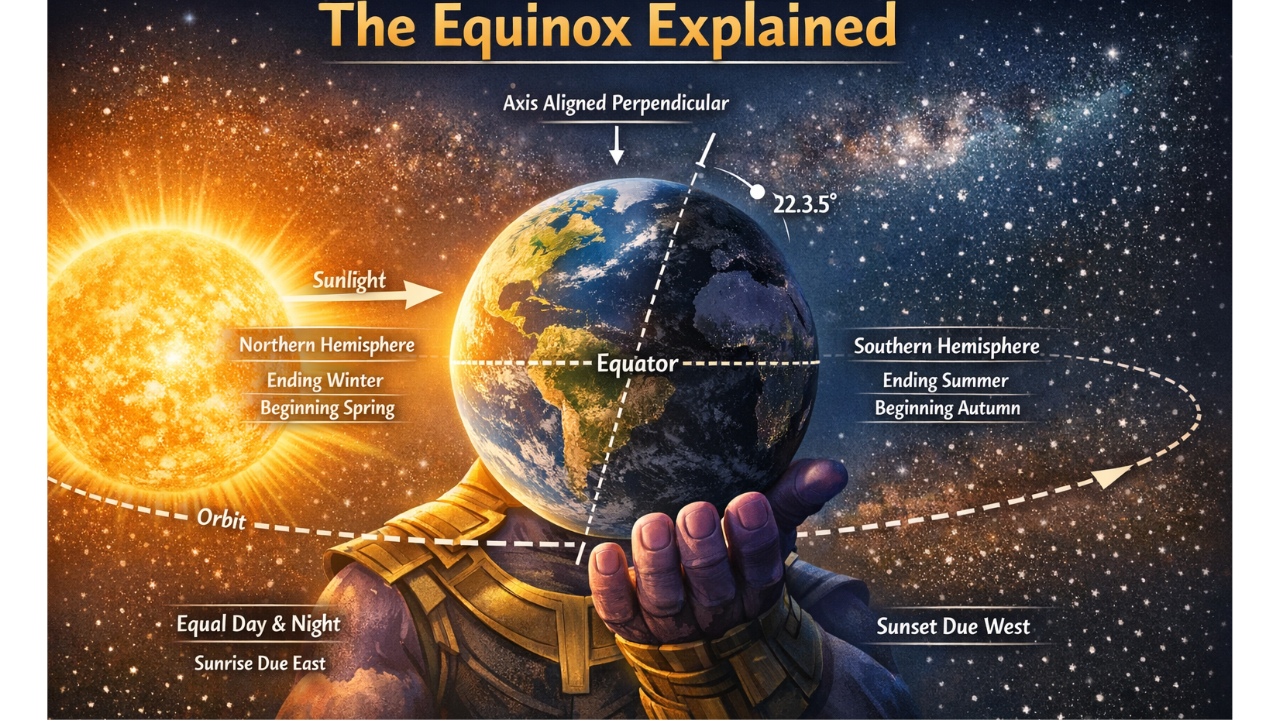
The equinox explained in Thanos’ perfectly balanced way
What the living world hears
The equinox is not just an astronomical event. It is a biological signal encoded in light. The mechanism is photoperiodism, the ability of organisms to measure day length.Plants respond as daylight crosses critical thresholds. Trees begin producing chlorophyll, buds open, and growth resumes. Across continents, from the cherry blossoms of Tokyo to rhododendrons in the Himalayas, spring unfolds in response to increasing light.Birds experience hormonal changes triggered by longer days. These changes prepare them for breeding and drive migration patterns. Billions of birds are now in transit between wintering and breeding grounds, guided by solar and stellar cues.Even oceans respond. In northern seas, increasing sunlight triggers vast phytoplankton blooms, forming the base of marine food chains and playing a major role in absorbing atmospheric carbon dioxide. The equinox, in this sense, connects biology with planetary chemistry.
Climate change and a shifting rhythm
While the equinox itself remains fixed, the natural systems tied to it are changing. Spring is arriving earlier across much of the Northern Hemisphere. Trees leaf out sooner, flowers bloom earlier, and migratory birds shift their schedules.These changes are uneven. Some species adapt quickly, others do not, creating mismatches between predators and prey, or pollinators and plants. This phenomenon, known as phenological mismatch, is becoming a significant ecological concern.In the Arctic, warming is especially visible. Sea ice is reduced, permafrost is thawing, and snow is melting earlier. The equinox still arrives precisely on time, but the seasonal processes that follow are increasingly out of sync.
The civilisations that watched
Long before modern science, human cultures tracked the equinox through observation and ritual.At Chichen Itza, the pyramid of El Castillo produces a striking visual effect during the equinox, where light and shadow create the illusion of a serpent descending its steps. In Egypt, the Sphinx faces the rising equinox Sun. Stonehenge, though best known for solstice alignments, also reflects awareness of solar movement.Today, Nowruz, the Persian New Year, is celebrated by more than 300 million people. It marks renewal, rebirth, and the beginning of a new cycle of life, centred around the symbolic haft-seen table.In India, the same seasonal shift is marked as Gudi Padwa, the traditional New Year. Celebrated on the first day of the Chaitra month, shortly after the equinox, it follows the lunar cycle rather than the exact astronomical moment. Homes are cleaned, colourful rangoli patterns decorate entrances, and a gudi, a silk cloth raised on a bamboo pole and crowned with a metal vessel, is displayed as a symbol of victory and renewal. The ritual reflects the same transition in nature, where longer days and warmer air signal a fresh beginning.In Japan, the spring equinox is observed as a public holiday, a time for visiting ancestral graves and reflecting on continuity between generations. Across cultures, the meaning converges: balance, renewal, and the return of light.The equinox reveals a deeper truth: that the universe operates through geometry, and over time, that geometry becomes culture.
A moment worth marking
There is something worth pausing for in the equinox. Not as mysticism, but as a precise, observable moment of balance. The same tilt that produces winter’s darkness and summer’s abundance is, briefly, neutral, giving both hemispheres equal access to sunlight.The cherry trees know it. The swallows know it. The phytoplankton know it. Three hundred million people celebrating Nowruz know it. Families raising gudis across India know it. And the astronomers who tracked the exact second of crossing, 10:01 GMT, this morning, March 20, 2026, know it with a precision unimaginable to earlier civilisations.What unites them is a shared recognition: we live on a tilted planet orbiting a star, and that tilt, set in motion billions of years ago, has shaped everything.