
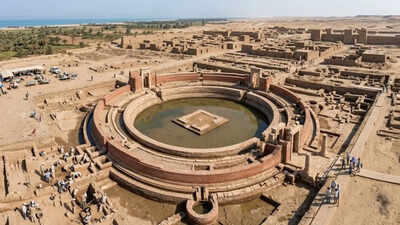
The excavation at the Tell el-Farama site in northern Sinai by an Egyptian archaeological team has concluded and resulted in the discovery of a rarely-seen round temple within the ruins of the ancient city of Pelusium, which also has a new identity than previously believed. According to the Biblical Archaeology Society, although this temple was thought to have been identified as a Town Hall when it was discovered in 2019, it has now been determined to have had a different purpose after archaeologists found evidence of hydraulic technology associated with the temple’s use.The round temple was built in the second century and remained in use until the sixth century AD. Its main feature was a circular basin that measured approximately sixty-five feet in diameter, where water from the Nile would have been stored for use as a source of water to irrigate the land near the temple. As a result of the research conducted on this temple and its features, the experts now believe that the temple was dedicated to the worship of the local god Pelusius, and there exists an extraordinary blend of ancient Egyptian, Greek, and Roman architectural styles in the construction of the temple and its adjacent structures.
Discovery of a rare circular temple built for water worship in Pelusium
As noted in the State Information Service, the structure has a diameter of 35 meters and a square base that served as the foundation for what likely was a large statue of the deity it represents. Fired red brick, which was used primarily in Roman hydraulic works, has allowed this site to remain a functioning water complex for thousands of years. The builders used the Pelusiac branch of the Nile to furnish the basin with living water, which played a key role in ancient Egyptian rituals of purification and was the symbol of fertility and cosmic balance.
Why was this not an administrative building
In 2019, archaeologists discovered the circular walls of the site, which were previously thought to be political in function, but the interpretation of the site has changed drastically as more excavations have been conducted. Complex drainage systems, kisterns and multiple entrances indicate that this site was a specialist religious site, not a political administrative building as originally surmised. The connection of the deity Pelusium and the Greek term for ‘silt’ or ‘clay’ implies that the site was closely associated with the fertile silt of the Nile and the life-giving powers of nature.
The historical significance of the Pelusium site
Pelusium was a culturally rich site and safety point for travellers for over a thousand years; as a result, it has played an important role in the collective history of humanity. For those travelling through the Sinai desert area, the port city marked the beginning of their journey into Egypt and provided access to goods that would be sold in Egypt. Furthermore, the temple of Pelusium’s unique and beautiful buildings are an ‘outstanding reflection of humane interaction’ by blending the traditions of the indigenous Egyptians with architectural designs that were brought to Egypt during the time of the Hellenists and later the Romans. Additionally, this long-standing tradition demonstrates how the Nile’s water has continued to be a source of spiritual and cultural nourishment throughout the eastern Mediterranean region long after its creation.